
“As iron sharpens iron, so one person sharpens another.” — Proverbs 27:17
One of Barbados’ oldest problems still swings from our trees.
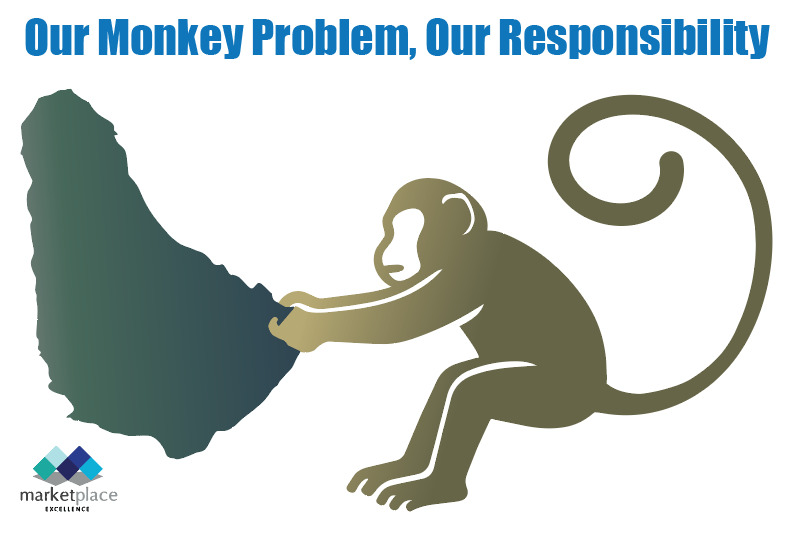
The green monkey arrived from West Africa some 350 years ago. Today, it is both mascot and menace. Tourists smile for selfies. Farmers and households count their losses. On an island of just 166 square miles, tens of thousands of monkeys mean one thing: too many monkeys and too little space.
So whose job is it to fix this? The answer is everyone’s. But “everyone” only works when each of us understands our role. Otherwise, we argue while the troops multiply.
The government must lead. The Ministry of Agriculture, Food and Nutritional Security, through its Green Monkey Management Unit, sets policy and must fund action. That means expanding immunocontraception darting, enforcing animal-proof waste bin regulations, negotiating ethical export agreements for research, and providing fair compensation for crop losses. Policy without funding is merely talk. Leadership without follow-through is even worse.
Farmers and businesses must also act. Your first line of defense is on your own property. Invest in netting, electric fencing and secure storage. Hotels and restaurants should secure dumpsters, cover compost and eliminate easy food sources. If you profit from the Barbados brand, you should also invest in protecting it. Report damage, support community compensation initiatives and do not wait to be rescued.
Citizens must change their behavior. Every roadside banana and every unsecured garbage bin is population control in reverse. “Don’t feed the monkeys” is not a cute slogan. It is sound management. Secure your garbage, report troop sightings and participate in public education efforts. Responsibility begins at your gate, not at the Government’s office.
NGOs and researchers have an essential role to play. We need science, not sentiment. That means developing safer fertility-control methods, producing accurate population data, improving humane trapping techniques and documenting the true extent of crop losses. Universities and research partners must move beyond pilot projects to islandwide solutions.
Killing monkeys alone will not solve the problem. They reproduce quickly, and public sentiment will not support the mass culling of a national symbol. The solution is shared management. The government must establish and enforce policy. Farmers must secure their farms. Citizens must stop feeding monkeys. Scientists must provide effective tools. When all four work together, monkey numbers will decline, and so will conflict.
The green monkey is not leaving Barbados. But “serious predator” does not have to mean “national crisis.” Barbados has always survived by managing what it cannot remove. That process begins the day each of us accepts responsibility for our part.
Dr. Basil Springer, GCM, is a corporate governance adviser. His email address is basilgf@marketplaceexcellence.com. His columns may be found at www.nothingbeatsbusiness.com.