
“Let every soul be subject to the governing authorities.” — Romans 13:1
In my journey of writing about entrepreneurship and development, I have often reflected on the role of government in driving economic growth. One area that consistently stands out is the governance and management of State-Owned Enterprises (SOEs). These entities play a vital role in delivering essential services, yet they frequently struggle with political interference, inefficiency and poor performance.
In Barbados and across the Caribbean, the minister responsible for the ministry under which an SOE falls usually appoints a political Chairman and the Board of Directors. The Board, in turn, appoints the Chief Executive Officer and senior staff. This structure opens the door to political appointments throughout the organisation, often resulting in weak management, low efficiency, financial losses, and an undue burden on the taxpayer.
In 1981, I was appointed the apolitical Chairman of the Barbados Marketing Corporation for a three-year period. I say apolitical because I was not interested or involved in politics. One may say that this was a departure from the norm.
The minister appointed three members of the Board, and I appointed three others, all of whom were endorsed by Cabinet. We inherited an organisation plagued by inefficiency and poor systems, and it required decisive action and disciplined governance to turn it around. The records would show that the board was successful.
Later, during a visit to Singapore, I learned of a markedly different and highly effective approach to SOE governance. There, the minister appoints a highly qualified, professional CEO. That CEO then selects a suitable chairman and board, based on competence and experience, to achieve the enterprise’s objectives. This model further prioritises meritocracy and accountability, significantly reducing the risk of political interference and corruption.
There are important lessons here for the Caribbean. By structuring SOEs as companies with the government as the sole shareholder, and by engaging private-sector management principles to run operations, we can significantly improve efficiency and performance while insulating these enterprises from political influence.
As I reflect on my life’s work, I am reminded that good governance, integrity and compassion are foundational to building successful enterprises and strong communities. By embracing merit-based leadership and adopting proven governance models such as Singapore’s, we can create more resilient economies and a brighter future for our islands. Good governance in SOEs is not optional — it is essential for sustainable development.
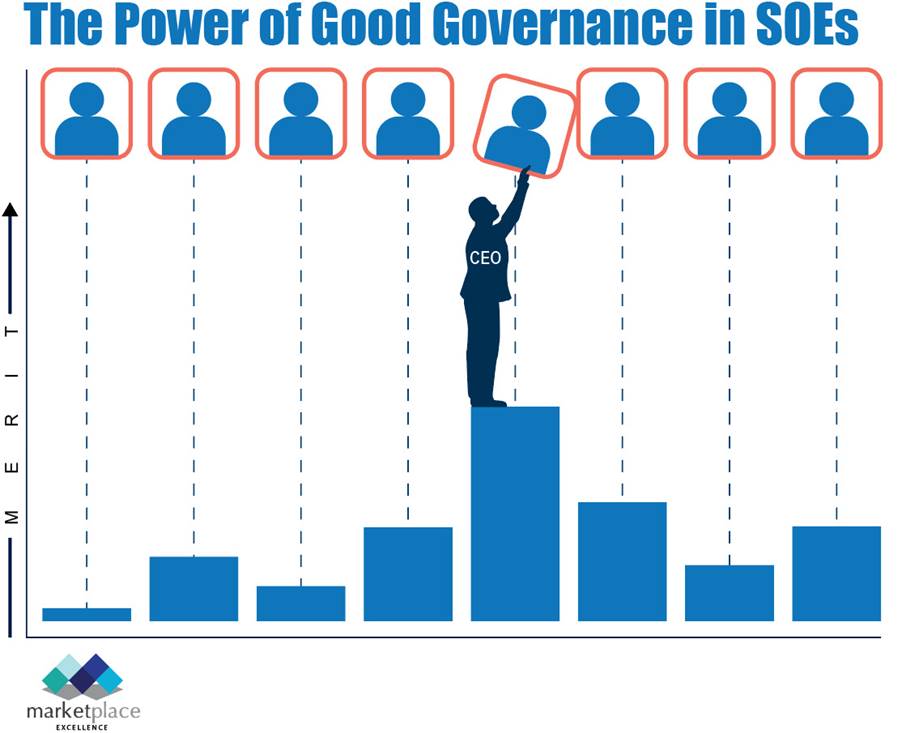
image.jpegDr. Basil Springer GCM is a corporate governance adviser. He can be reached at basilgf@marketplaceexcellence.com. His columns may be found at www.nothingbeatsbusiness.com.